



Jim Reeder
Parent Carer Empowerment Project
What is this research about?
Around the world, nearly one in ten children have a health condition that affects their ability to carry out everyday activities. Most of these limitations are linked to problems with the brain or nervous system and are referred to as neurodisability. Many children with neurodisability experience delayed development, difficulty taking part in social activities, and poorer health, educational and employment outcomes later in life.
Healthcare services for children with neurodisability have made a strong commitment to working closely with families. This means working in partnership with parents and carers and supporting them to make decisions about their child’s care. However, many parents say they struggle to do this because services can be difficult to navigate, support is limited, and there is still an imbalance of power during healthcare appointments.
To improve this situation, healthcare service providers may need to focus on helping parents and carers to gain a greater sense of agency, influence and control over the decisions about their child’s care. This process is known as parent carer empowerment. It involves helping parents and carers understand their situation better and use that understanding to gain more control over their own lives and the lives of their children.
What did we want to know?
In this programme of research, we wanted to find out the following:
- what is already known about interventions that promote the empowerment of parents and carers of children with neurodisability?
- what does parent carer empowerment mean to the people it involves and what factors affect it?
- what new ways of working might help promote parent carer empowerment?
- are these new approaches appropriate and acceptable to the people they involve?
What have we done?
The programme of research included three stages: a preparatory stage, an intervention development stage, and an intervention testing stage. Each stage was carried out in collaboration with a group of parent carer partners.
The preparatory stage included two studies. The first, a scoping review, involved a comprehensive search for information about existing interventions or programmes that aim to promote parent carer empowerment. The second involved interviews and focus groups with parent carers, service providers and other interested stakeholders to find out their views and experiences of parent carer empowerment. The information collected from these studies was carefully processed and used to inform the intervention development stage.
During the intervention development stage we used an approach called Theory of Change, which helps people work together to plan how change can happen. This involved working closely with a group of parents and other important stakeholders to co-design a new way of working to promote parent carer empowerment.
In the testing stage, we shared our proposed new approach with a wider group of people involved in this area of care. Their feedback helped us to refine and improve the intervention design.
What have we learned?
We found 145 different programmes that had been designed to promote some aspect of parent carer empowerment. Nearly all of these programmes were aimed directly at parent carers, and there were some common issues related to delivering them sustainably in real-world settings.
From the interviews and focus groups, we found that a range of factors influence whether parent carers feel empowered or disempowered. We developed this diagram, which showing how these factors interact within a complex system.
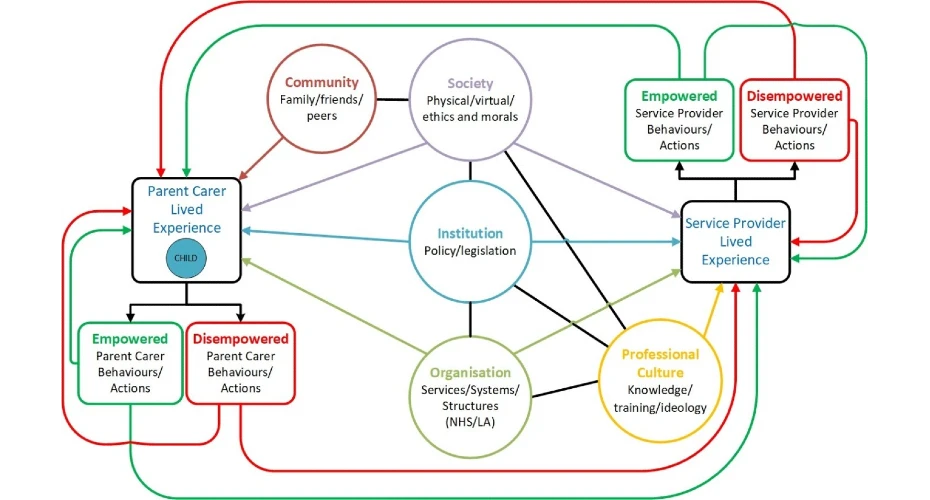
An important part of this complex system was the interaction between parent carers and service providers, so this became the focus of the new intervention.
The first version of the new intervention had three parts:
- two workshops for service providers
- three practice changes
- ongoing supervision.
After initial testing, we found that service providers liked the idea of our new intervention, but they preferred to develop their own practice changes that would be better suited to the places they worked. We also found that service providers themselves needed to feel empowered to have control over their professional lives and to make changes to their practice.
These findings led to some important changes to the intervention design. Instead of providing pre-determined solutions, the intervention shifted towards creating the conditions for service providers to better understand their own situation and develop their own ideas for change.
What are we planning to do next?
We will share the findings of this research widely using a range of strategies for different audiences. We will continue to collaborate with parent carer partners to co-design the content and materials for the new intervention and will carry out further, more detailed testing. The long-term aim is to demonstrate the value of the new intervention and to support its wider use across different child healthcare settings.
- Study 1: Reeder, J., Rogers, M., Harniess, P., Shamsaddin, F., McGlinchey, C., Smith, J.R., Kendall, S. and Morris, C., 2026. Interventions supporting the empowerment of parent carers of children with neurodisability and other long‐term health conditions: A scoping review. Developmental Medicine & Child Neurology, 68(4), pp.489-500.
- Study 2: Reeder, J., Minhas, S., Foxwell, S., Williams, M., Smith, J.R., Kendall, S. and Morris, C., 2026. Exploring Parent Carer Empowerment in Childhood Onset Disability: A Qualitative Study. Health Expectations, 29(4), p.e70808.
- Study 3: Reeder, J., Minhas, S., Breuer, E., Smith, J.R., Kendall, S. and Morris, C., 2026. Empowering Parent Carers of Children With Neurodisability in Healthcare Settings: Co‐Producing a Theory of Change for Intervention Development. Health Expectations, 29(5), p.e70871.
Funding:
This project is part of doctoral research funded by the National Institute of Health Research (NHIR) as part of a Doctoral Clinical and Practitioner Academic Fellowship awarded to Jim Reeder (NIHR302886).
Please contact Jim Reeder for further information jr898@exeter.ac.uk